Nissan Interstar - ABC Leasing
INTER STELLAR?(some text hidden)
By Jonathan Crouch
Ten Second Review word count: 47
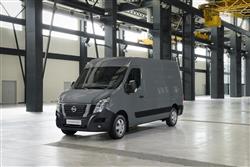
Nissan re-invents its largest van, the Interstar, for a new era. It now has a sharper look, a totally redesigned cabin and a completely new level of media connectivity and drive assist features. The diesel engines are more familiar, but they're now joined by a full-EV version.
Background word count: 152
You might be forgiven for not even knowing that Nissan made a really large van. Partly because the last generation version of the model it sold couldn't decide over its lifetime whether it wanted to be called 'NV400' or 'Interstar'. It's 'Interstar' now and, like all other Nissan LCVs, is Renault-based, in this case created around the engineering of the fourth generation Renault Master. Which means it's a cutting-edge commercial product based around a platform that can accommodate three power sources - diesel, electric and hydrogen. Whatever your choice of variant, Nissan claims it will be able to go further, carry more and cost less than its predecessor. Well, cost less to run anyway. The Japanese brand reckons it's 'the ultimate ally for essential businesses that keep society running', but every large LCV in the segment claims to be that. Why might your company want this one? Let's take a closer look.
Driving Experience word count: 381
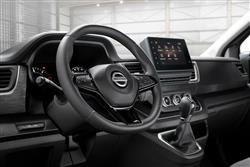
Nissan's proud of this second generation Interstar's 'truck'-style looks, but operators won't want a 'truck'-style driving experience. And of course that's not served up here. Mainly because all the drivetrains come bolted to a completely new 'Multi-Energy' platform which has apparently been developed for three different power sources - diesel, electric and hydrogen, though Nissan says it has no plans to offer a hydrogen-fuelled Interstar in the UK market. That platform has also been developed to accommodate both front and rear-driven formats, though all British-bound Interstars will be front-driven. For the time being, most of them will be diesel-powered too; right at present, the least likely class of van to be fully-electric is a really large one. To ease the transition a little, you might have though that the Renault Nissan Alliance would have developed a mild hybrid system to add into this LCV's core 2.0-litre Blue dCi turbo diesel engine, but nothing like that's offered here, though efficiency's usefully improved - as you'll learn in our 'Cost 'section. The Interstar gets this unit in a slightly wider range of flavours than the Renault Master does, with a 105hp variant added in at the foot of the line-up. But the core versions of this powerplant are shared between the two models, developing either 130hp, 150hp or 170hp, with the latter two offering the option of 9-speed automatic transmission. As before, four cylinder unit is a willing, torquey thing, with pulling power rated at up to 380Nm in 170hp form. For our test, we chose to try the all-electric Interstar-e. From launch here, this EV variant was offered with the option of a smaller 40kWh battery, but Nissan quickly discontinued that because it turned out that everyone wanted the more usable 87kWh battery we tried, which is rated at up to 285 miles between charges and is paired with a 143bhp motor developing 300Nm of pulling power. You'll need to restrain yourself from using all of that torque if you're to get anywhere near the EV mileage figure we just quoted. To manage that, you're also going to have to virtually always engage this 'ECO' button on the dashboard (which dampens throttle response considerably); and make sure you always engage the 'B' regenerative drive format via this gearchange stalk behind the wheel.
Pictures (High res disabled)
.jpg)
.jpg)
.jpg)
.jpg)
.jpg)
.jpg)
.jpg)
.jpg)
Scoring
Category: Compact Car
| Performance | |
| Handling | |
| Comfort | |
| Space | |
| Styling | |
| Build | |
| Value | |
| Equipment | |
| Economy | 80% |
| Depreciation | 60% |
| Insurance | 70% |
| Total | 69% |
Mobile
Narrow
Narrower
Normal
Wide