


CIVIC STATEMENT (some text hidden) --NONE--
By Jonathan Crouch
Introductionword count: 51
This eleventh generation Honda Civic switched to e:HEV full-Hybrid power in its mainstream form - and adopted a lower key look. It's slightly larger than its direct family hatch rivals from the 2022-2025 period and delivers everything its brand knows about petrol/electric technology. Which turns out to be quite a lot.
Modelsword count: 8
5-door Hatch [(2.0 Hybrid petrol) Elegance, Sport, Advance]
Historyword count: 292
The Honda Civic, one of the global motor industry's most enduring model lines moved on in MK11 form, launched in 2022. By then, it was no longer built in Swindon. And mainstream versions of this eleventh generation version no longer used a conventional engine, instead adopting a 2.0-litre e:HEV full-Hybrid petrol powerplant that was anything but conventional. Bringing new technology like this to compact, versatile family models of this kind was always a passion of company founder Soichiro Honda. Back in the Sixties when the best the motor industry could offer a small family was something like a lumbering Morris Oxford, it was he who pioneered the idea of a compact fuel and space-efficient family car with a hi-tech air-cooled flat-four 1300cc engine. It was thinking that led to the launch of the original Civic in 1972, a model series that over the next half a century would go on to sell over 27.5 million cars across 170 countries around the world. With this eleventh generation version, there was a return to the more mature look of earlier generation Civic designs; gone are the slashes and fake vents of the old MK10 model. Instead, this replacement liftback 5-door hatch design adopted a more conservative, but still sophisticated look. This car completed the shift of Honda's entire model line to e:HEV Hybrid technology. Well, almost the entire model line anyway. Back in 2022, the company, thankfully, couldn't quite bring itself to abandon the Civic Type-R hot hatch, so that continued for three more years with an evolved version of the previous model's 316bhp 2.0-litre turbo powertrain. But the Civic e:HEV is our focus here. This MK11 Civic was updated in mid-2025, but it's the pre-facelift 2022-2025-era versions of it we look at here.
What You Getword count: 486
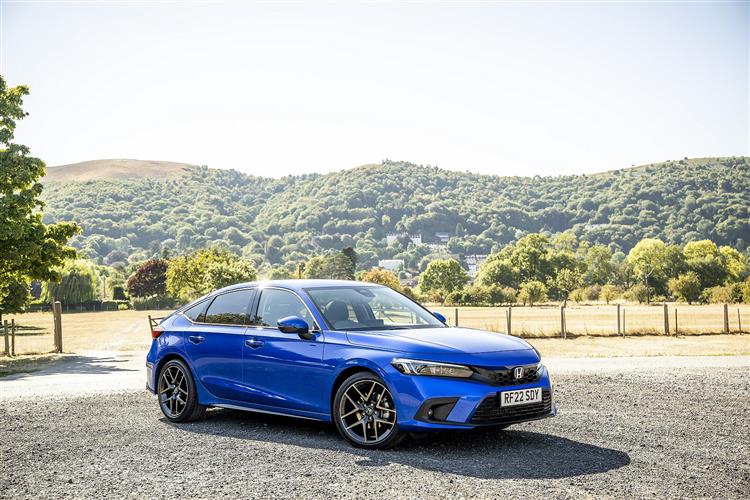
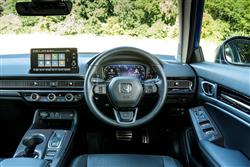
The boldness of Civic design seems to alternate with generation. In this MK11 form it does have more of a mature look - though even that wasn't really what the designers were going for, the wheelbase stretched by 35mm here in pursuit of 'a sporty coupe-like aesthetic'. That's why overall height was reduced, with the tallest part of the swept-back roof line set further forward. Plus the A-pillar was moved back 50mm, the rear overhang is 20mm shorter than before and the wheels are relatively large, at either 17 or 18-inches in size. At the front, there's a sharper bumper design this time round, a mesh panel in the upper grille delivering what Honda hoped was a sportier look. At the rear, the tailgate deck height was positioned lower, as were the combination rear lamps. Get behind the wheel and it's quickly apparent that it's less about what's been added and more about what's been taken away. A huge reduction in button clutter means a return here to the simpler interface of the earliest Civics, as part of what Honda calls a 'human-centred' approach to interior design. You'll immediately notice the honeycomb mesh-trimmed vent strip, which stretches away across to the passenger side and via three silver toggle switches can diffuse the air being emitted, avoiding the usual wind-in-your face sensation. The other pleasant surprise might be the seats, which are a lot more comfortable than those of the previous generation model, thanks to so-called 'body stabilising' design. The screen tech was a big step forward too, this 9-inch centre Honda CONNECT infotainment screen featuring cutting-edge stuff like over-the-air updates, 3D urban modelling and a much improved 'Personal Assistant' voice command system. The instrument binnacle has 7-inch 'Multi Info' meter display dials in base and mid-range variants but a configurable 10.2-inch screen with virtual dials in the top 'Advance' version. You wouldn't mistake this interior for the cabin of a premium brand model, but build quality is excellent, the ergonomics are almost faultless and everything's really nicely trimmed too. Let's consider the back seat. At 4.55-metres, this car is the longest model in its class and its 1.41-metre roof height is also the lowest. That roof height issue is something you'll notice when leaning across to strap down child seats - and when getting in. Inside, Honda claimed that despite the lower roof line, actual interior ceiling height was the same as it had been in the previous generation model, thanks to the way that the tailgate support hinges were moved outwards. But taller folk might still want more headspace back here, particularly on models fitted with the big panoramic glass roof. We've got no complaints about leg space though, which improved with this MK11 design by 35mm and is better than you'd get from most class rivals. As for the boot, well once the hatch rises, you're offered a cargo area that's 410-litres in size.
To see the full road test text contact us on 0330 0020 227
Pictures (high res disabled)
.jpg)
|
.jpg)
|
.jpg)
| |||
.jpg)
|
.jpg)
|
.jpg)
| |||
.jpg)
|
.jpg)
|
.jpg)
| |||
.jpg)
|
.jpg)
|
.jpg)
| |||
.jpg)
|
|
Scoring (subset of scores)
Category: Compact Family Cars
| Performance | |
| Handling | |
| Comfort | |
| Space | |
| Styling, Build, Value, Equipment, Depreciation, Handling, Insurance and Total scores are available with our full data feed. | |

